The income gap

Young women face inequality from the very start of their working lives. On average, a young woman will earn £4,000 a year less than a young man of the same age – we call this the income gap. 

The income gap reflects differences in total annual earnings, which are shaped by both: 

  •  Hourly pay differences (often referred to as the gender pay gap) and 
  • Differences in hours worked and employment patterns. 

While the official gender pay gap focuses on differences in hourly pay rates, this on its own understates the full inequality young women experience. When we look at annual earnings, the picture shows far more pronounced financial inequality – and for some groups of young women, such as those from racially minoritised communities, the income gap is even larger. 

This gap continues to grow over the course of a woman’s working life — so tackling it early is crucial to giving young women a fairer financial future. 

Why does it happen?

They still face discrimination in the workplace – holding them back from progressing, reaching their potential, and earning what they should. 

The income gap exists for several inter-related reasons: 

  • Young women are more likely to work in lower paid jobs and sectors – and getting stuck there. 
  • They are more likely to work fewer hours, including in part-time work where rates of pay are typically lower. 
  • They’re taking on more unpaid work, such as childcare, which limits the hours they can work. 
  • They still face discrimination in the workplace – holding them back from progressing, reaching their potential, and earning what they should. 

At a time in life when young women should be growing, learning, and taking chances, they’re instead too often trapped in a struggle just to get by. 



a young woman stares

The Income Gap: The scale and causes of pay inequality for young women in the UK 

We commissioned economists at Braw Data to analyse official labour market statistics to understand the extent of the pay differences between young women and young men, and their causes. 

Read the report
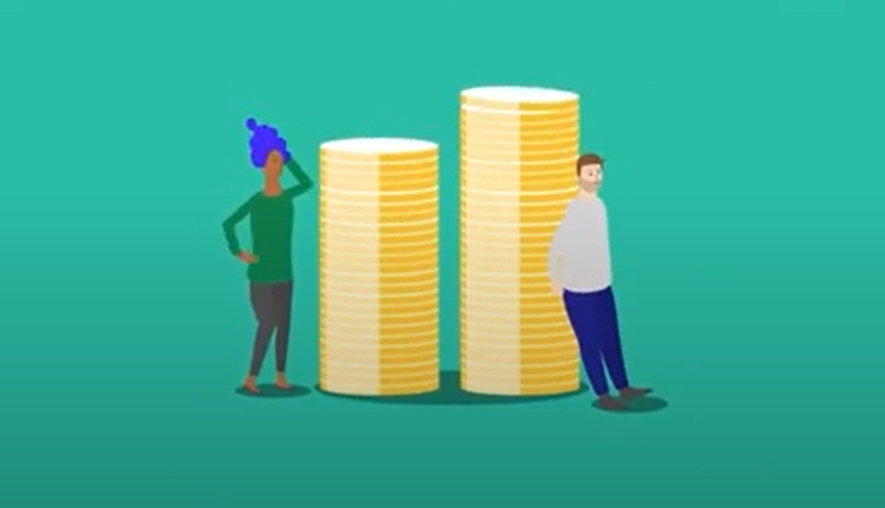
Play videoA cartoon-style illustration of a young woman scratching her head next to a stack of coins. A man next to her is leaning against a large stack of money.

The income gap explained

Young women face inequality from the start of their working lives, earning around a fifth less than young men. So why does this happen? 

The income gap explained video transcript

Watch the video

How is the income gap calculated? 

Employer data is analysed each year by the Office for National Statistics (ONS).  

Their  ‘Annual Survey for Hours and Earnings’ shows that, in 2025: 

  • In the 18-29 age range, young men’s weighted average annual earnings were £28,686. 
  • For young women this figure is £24,634 
  • That’s a difference of £4,052 

How to address the income gap

We are asking employers to take the following steps to help address inequalities: 

  • Stop asking candidates for salary history, which can trap young women in low-paid pay trajectories. 
  • Review and publish gender pay gap data, and start recording pay gaps by age band and ethnicity. Use this data to create targeted action plans. 
  • Design jobs flexibly: where roles can be done part-time, as job shares, remotely or flexibly, make this clear in job adverts. 
  • Provide meaningful development opportunities for young women, including mentoring, sponsorship and progression pathways. Monitor outcomes to assess impact. 
  • Support and resource young women’s networks within organisations. 
  • Build inclusive workplaces by investing in diversity and inclusion training, tackling discrimination, and implementing flexible and hybrid working policies that respond to real life and individual circumstances.