
National Co-production Week champions the power of co-production in shaping better, more inclusive services. Set up by The Social Care Institute for Excellence (SCIE), it runs from 29th June – 3rd July every year, during which organisations celebrate the work they do with people with lived-experience.
To celebrate this year, we asked our Changemakers and the Voice and Involvement Team to reflect on their experiences of co-production.
Eleanor – Senior Voice and Involvement Officer
For us on the Young Women’s Trust Voice & Involvement team, co-production is about ensuring that the young women we work with and support are involved meaningfully in shaping and prioritising our work.
It’s all well and good us thinking that we are doing is in line with what young women want and need, but we can only guarantee this by having young women sit at the table with us.
This comes back to our organisational value of Keeping It Real – ensuring that everything we do is grounded in the realities of young women’s lives and experiences.
Co-production can look different depending on the type of project, and it is important that we are clear with staff, and young women, about the different types of co-production, and what the expectation will be. However, in my experience, co-producing with young women only makes the work clearer and more transparent. It requires us to be clear about project goals, timeframes, and intentions, and to make sure that information is accessible and doesn’t assume prior knowledge.
For me, the real benefit of co-production is the wealth and breadth of ideas that come.
A fresh pair of eyes, a different way of doing things, someone who can say ‘ok you’ve always done it like that, but why?’, or ‘I see what you’re trying to do, but from the outside it’s just not landing’. When done properly, it feels like a real transfer of experience and skills. Hopefully, the young women involved in co-production projects with us come away with a deeper insight to our organisation, and perhaps a firming up of skills or experiences they were hoping to develop. For us, we have richer and sounder project outcomes.
Co-production can take additional thought, time, and consideration. But we’ve seen the benefits play out on many an occasion and are incredibly grateful to the young women working with us in this way.
Sara – Changemaker in our Rights Here, Rights Now campaign group
Co-production only works when there is a deliberate consideration for one another. Whether that be in regard to simple thoughts and ideas or whole projects. At Young Women’s Trust, co-production is the way voices are heard and more importantly change is implemented.
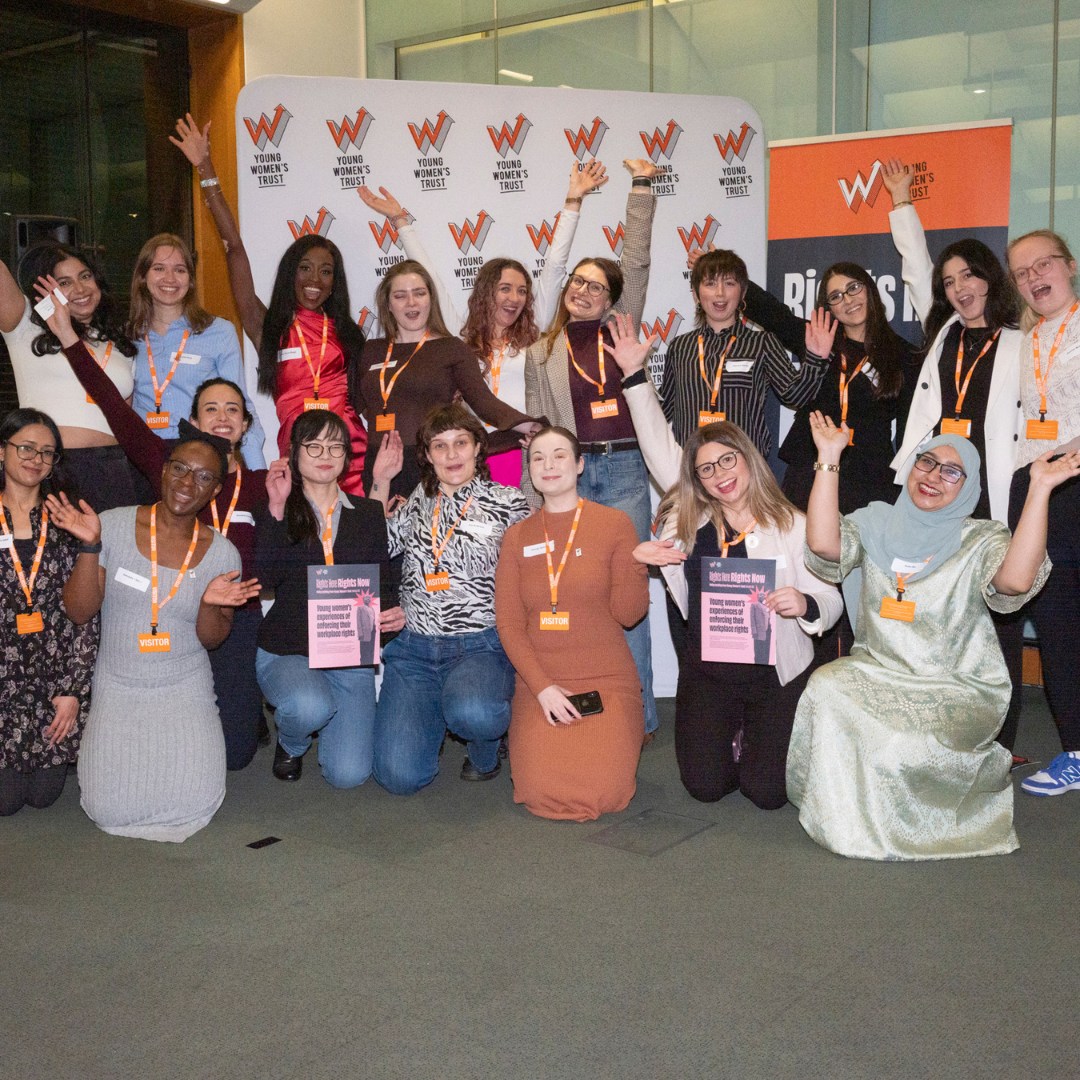
Since I began working as Changemaker, as part of the Rights Here, Rights Now campaign, I’ve seen this idea in full effect.
Young Women’s Trust actively encourage healthy discussion within the co-production space, and give everyone the ability to speak up.
I find it to be one of the safest spaces to be able to talk and contribute. As young women, our voices are constantly being hushed or hindered by another voice that’s usually louder and more imposing, but there’s no sense of that here.
In the near 18 months, the working group have found a steady flow, always prompting one another to elaborate and collaborate. For example, when it comes to raw material in focus groups that needs developing, there’s no judgement when an idea is not fully formed. Instead, I’ll be prompted by another member or Young Women’s Trust staff to make additions or clarify with suggestions on what the idea could lead to. Co-production and collaboration work in the same vein, and I find forms the ethos of this working group. I’m so grateful to have found my place in such a wonderful group of people and to be able to be supported by Young Women’s Trust.
From the residential to the Zoom meetings, I couldn’t have asked for a more seamless journey into this campaign.
Loretta – Voice and Involvement Officer
When I think about co-production and what it means to me; I believe that if our mission is centred on the rights of young women, then co-production isn’t optional, it becomes the whole point.
In my role, I work with our Changemakers – young women who are part of our Rights Here, Rights Now campaign group. Working with them on the campaign, they aren’t waiting to be consulted, but are part of driving the conversation forward. Co-production acknowledges that young women aren’t just the people we work for, they’re the people we work with.
Working alongside young women in a genuine way has changed the way I work.
I now ask much earlier: where can young women shape this? Not as an afterthought, but as part of how a project is built. And it’s taught me to stay open; to hear feedback not as criticism, but as a tool to make our work better.
It’s also made me more honest about what I don’t know, more intentional about how I communicate, and more willing to let go of how things have always been done.
For me, co-production is also an act of accountability. It’s harder to lose sight of what matters when the people your work effects are actively shaping it.